

A Radiologist’s Introduction to Foundation Models:
The Best Time in History to Be a Radiologist
On Amazon Paperback and Kindle
On Amazon Paperback and Kindle
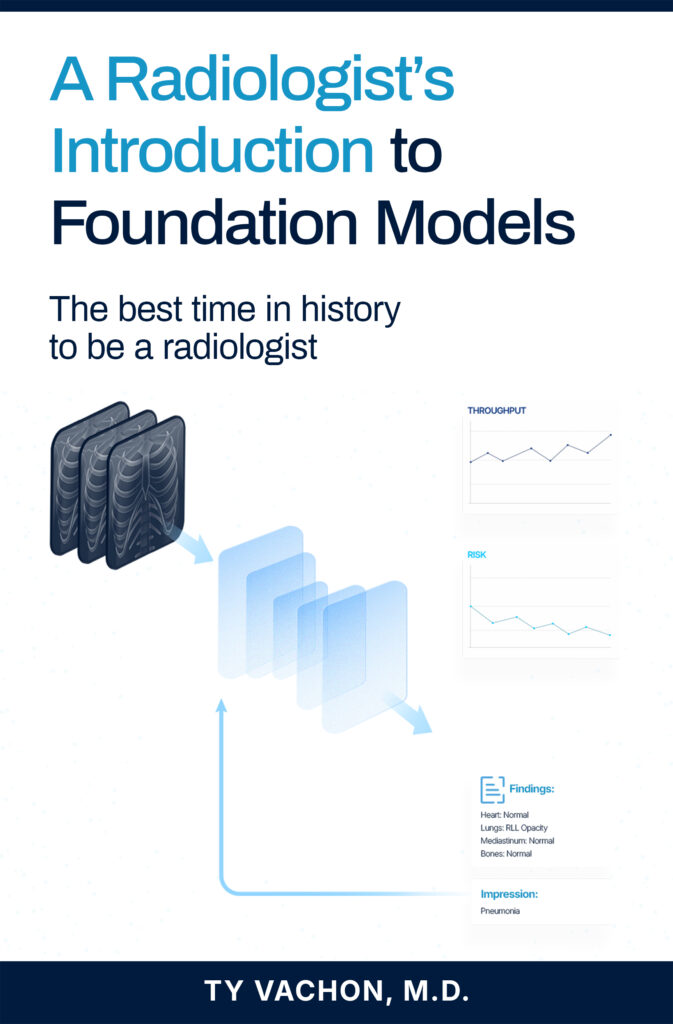
A Radiologist’s Introduction to Foundation Models explores the next major shift in medical imaging: the move from narrow AI tools toward foundation models capable of generating full radiology reports, understanding clinical context, and participating directly in imaging workflows.
Written for practicing radiologists, radiology residents, and imaging leaders, this concise and highly practical book explains how large language models (LLMs), vision language models (VLMs), and modern foundation models are beginning to reshape radiology departments, reporting workflows, quality assurance, and clinical operations.
Rather than focusing on hype or technical jargon, the book provides a clinically grounded framework for understanding where these systems fit into real-world radiology practice, where they may fail, and how radiologists can thoughtfully supervise and deploy them.
Topics include:
• The evolution from traditional narrow AI tools to foundation models/VLMs
• How multimodal AI systems generate draft radiology reports
• Human-AI collaboration and the changing role of the radiologist
• Workflow integration, supervision, and trust in AI-assisted reporting
• AI hallucinations, omission errors, and “mirage reasoning”
• Drift, disagreement monitoring, and post-deployment observability
• Regulatory, operational, and medicolegal considerations
• Why benchmark accuracy alone is insufficient in clinical practice
• The emerging need for AI governance and real-world monitoring infrastructure
The book is designed to “level the playing field” for radiologists and trainees who want a practical understanding of modern AI without needing a computer science background. Concepts are explained using clinical examples, workflow analogies, and real imaging use cases relevant to daily radiology practice.
This is not a coding manual or a deep technical textbook. Instead, it is an operational and clinical guide for understanding how AI is moving from isolated algorithms toward integrated reporting systems capable of affecting throughput, supervision burden, staffing, quality, and patient care.
As radiology enters the foundation model era, understanding these technologies is no longer optional for imaging leaders. The goal of this book is to help radiologists participate in shaping that future rather than reacting to it after the fact.